Why Your Tech Stack Decision Matters More Than You Think
We've seen it happen dozens of times. A founding team picks a technology in week one — often based on what they already know, or what's trending on Hacker News — and three years later they're either thriving because of it or spending six months migrating to something else entirely.
The tech stack is not a detail. It determines your team's productivity, your hiring pool, your cloud costs, your time-to-market, and ultimately your ability to scale when you grow. Getting it right early is one of the highest-leverage decisions in any software project.
Choose boring technology for infrastructure, proven technology for core systems, and modern technology only where novelty provides a real competitive advantage.
This guide is based on over 15 years of building production systems — web platforms, mobile apps, government registries, media broadcasting systems, and trading terminals. Not theory. Real decisions with real consequences.
Frontend: React, Vue, or Something Else?
The frontend choice is where most teams spend the most energy debating, and it's often the least consequential in the long run — because frontends can be rewritten. Still, it matters for team velocity, ecosystem, and hiring.
When we choose React
- Large teams with senior engineers who want explicit control
- Complex, data-heavy applications (dashboards, analytics, trading tools)
- Projects that will live for 5+ years — React's ecosystem stability is unmatched
- When you need a large talent pool for hiring
- Applications where server-side rendering matters (Next.js)
When we choose Vue
- Smaller teams or projects where developer experience and speed matter most
- Marketing sites, CMSs, and content-heavy apps
- Projects where the backend team also owns some frontend — Vue's template syntax is more approachable
- Government and institutional projects where procurement requires simpler onboarding
One thing we've learned: don't mix frameworks in a single codebase unless you have an ironclad reason. The hidden cost of context-switching between React and Vue components in a monorepo is brutal for team coherence.
Backend & API Layer
This is where the real architectural decisions live. The backend determines your data model, your API design, your performance ceiling, and your operational complexity.
Node.js (Express / Fastify / NestJS)
Our default choice for API-heavy applications, real-time systems, and projects where the frontend team also touches the backend. The shared language with the frontend reduces cognitive overhead significantly. We use Node for roughly 60% of new projects.
Node.js shines for: REST APIs, GraphQL servers, WebSocket services, microservices, and serverless functions. It struggles with CPU-intensive workloads — don't build a video encoder in Node.
PHP (Laravel)
Still the right choice more often than the industry admits. For content-heavy sites, CMS integrations, and projects where hosting simplicity matters, Laravel is unbeatable. Shared hosting support, mature ecosystem, and straightforward deployment make it excellent for government projects and NGOs with limited DevOps capacity.
C# (.NET)
Our choice when performance, type safety, and enterprise integration matter above all else. Financial systems, Bloomberg-style terminals, systems that integrate with Microsoft infrastructure — .NET is simply the right tool. It's also significantly faster than Node for compute-heavy tasks.
Don't start with microservices. Start with a well-structured monolith. Split only when you have real, measured scaling pain in specific areas. We've seen a dozen startups spend their first year building a microservices infrastructure nobody needed.
Database: SQL vs NoSQL
This one is simpler than the internet makes it seem.
Use a relational database (MySQL / PostgreSQL) as your default. If your data has relationships — users, orders, products, events — SQL is the right choice. ACID compliance, mature tooling, and decades of operational knowledge make relational databases the safe default 80% of the time.
Add MongoDB (or Redis) when you have a specific problem it solves better: unstructured documents with unpredictable schemas, high-throughput caching, or real-time pub/sub. We run MongoDB alongside MySQL on the Active Parks platform specifically for event logging — it handles the write volume that MySQL couldn't sustain at 100K hits/day.
// Use SQL when:
- Data has clear relationships (foreign keys)
- You need ACID transactions
- Schema is well-defined and stable
- Reporting and analytics matter

// Use NoSQL (MongoDB) when:
- Schema is truly variable / document-like
- Very high write throughput needed
- Horizontal scaling is a hard requirement

// Use Redis when:
- Caching query results
- Session storage
- Real-time pub/sub (WebSockets)
- Rate limiting
Infrastructure: Cloud, Containers & DevOps
Even a perfectly chosen language/framework stack fails without solid infrastructure. Here's what we run in production across all our projects.
Containerise everything from day one
Docker is non-negotiable. It eliminates environment drift, simplifies onboarding, and makes deployment reproducible. Every project we've built in the last 6 years runs in containers. The small overhead of writing a Dockerfile and docker-compose.yml pays back within the first week.
Observability isn't optional
We run Prometheus + Grafana for metrics, Graylog for log aggregation, and GoAccess for real-time traffic analysis on every production system. You cannot fix what you cannot see. Setting this up costs one engineer-day. Debugging a production outage without it costs a week.
Zero-downtime deployments
Whether it's blue-green deployment, rolling updates, or a simple load-balancer swap — plan for zero-downtime from the start. Retrofitting it later is painful and expensive.
The Decision Matrix We Actually Use
When a new project comes in, we ask five questions in this order:
- What's the team's existing expertise? The best stack is the one your team executes well. A PHP team building in Go will ship slower and produce lower-quality code than the same team in Laravel.
- What are the performance requirements? A blog and a real-time trading platform have radically different needs. Define your SLAs early.
- How many users in 3 years? Design for 10× your launch traffic, not 100×. Over-engineering for scale you'll never hit is expensive and demotivating.
- What's the integration landscape? Government projects often require specific authentication providers, data buses, and legacy systems. Let those constraints drive your backend choice.
- What's the hiring plan? If you plan to grow the team, pick a stack with a large talent pool in your geography.
Use the technology that your best available engineers know best, that has a mature ecosystem for your domain, and that you can hire for in your market. Everything else is noise.
Conclusion
The right tech stack is not the most exciting one, or the newest one, or the one with the most GitHub stars. It's the one that lets your team ship reliable software quickly, maintain it safely over time, and scale it when growth demands it.
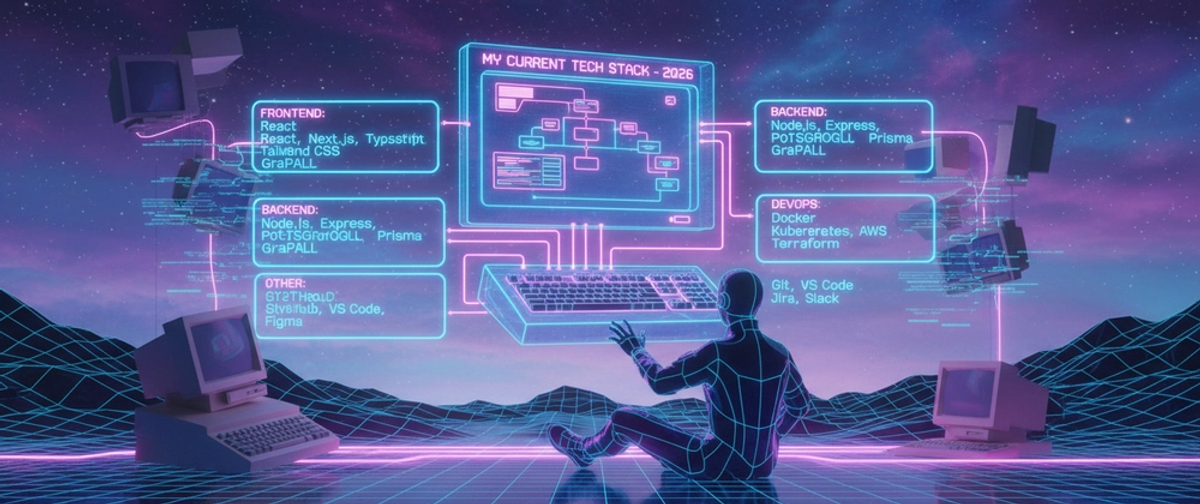
After 15 years and 50+ projects — government platforms, sports ecosystems, medical systems, trading terminals, and media infrastructure — our stack has remained remarkably consistent: React or Vue on the frontend, Node.js or .NET on the backend, MySQL + Redis as the data layer, Docker for deployment, and AWS or government infrastructure for hosting.
The technology is rarely the bottleneck. The team's understanding of requirements, the clarity of the architecture, and the quality of the engineering culture matter far more than any framework choice.
If you're starting a project and want a second opinion on your stack — get in touch. We're happy to review your architecture before you commit to it.